
How to fundraise for a nonprofit: 10 steps to create a fundraising strategy [+ 28 ideas]

Your nonprofit organization likely relies on a constant stream of revenue to fund your work and continue generating social impact.
Whether your organization is breaking individual donation records or working to boost incoming revenue, it’s always a good time to hone your nonprofit fundraising strategy — and invest in the right nonprofit software to consolidate your data and simplify how you manage and report on your success.
Eager to revamp your fundraising approach? In this article, we’ll explore effective fundraising strategies to engage donors, generate revenue, and take your nonprofit to the next level.
What is a fundraising strategy?
A fundraising strategy is a nonprofit’s plan for generating the revenue needed to run campaigns, engage donors, and power all programs related to your purpose. Fundraising strategies are not abstract concepts. They are explicit, documented instructions, goals, and processes viewable by your staff, supporters, board members, and the public.
Next, we’ll explain how to create a fundraising strategy and we’ll share some of the most effective fundraising ideas and tools to spearhead your campaigns.
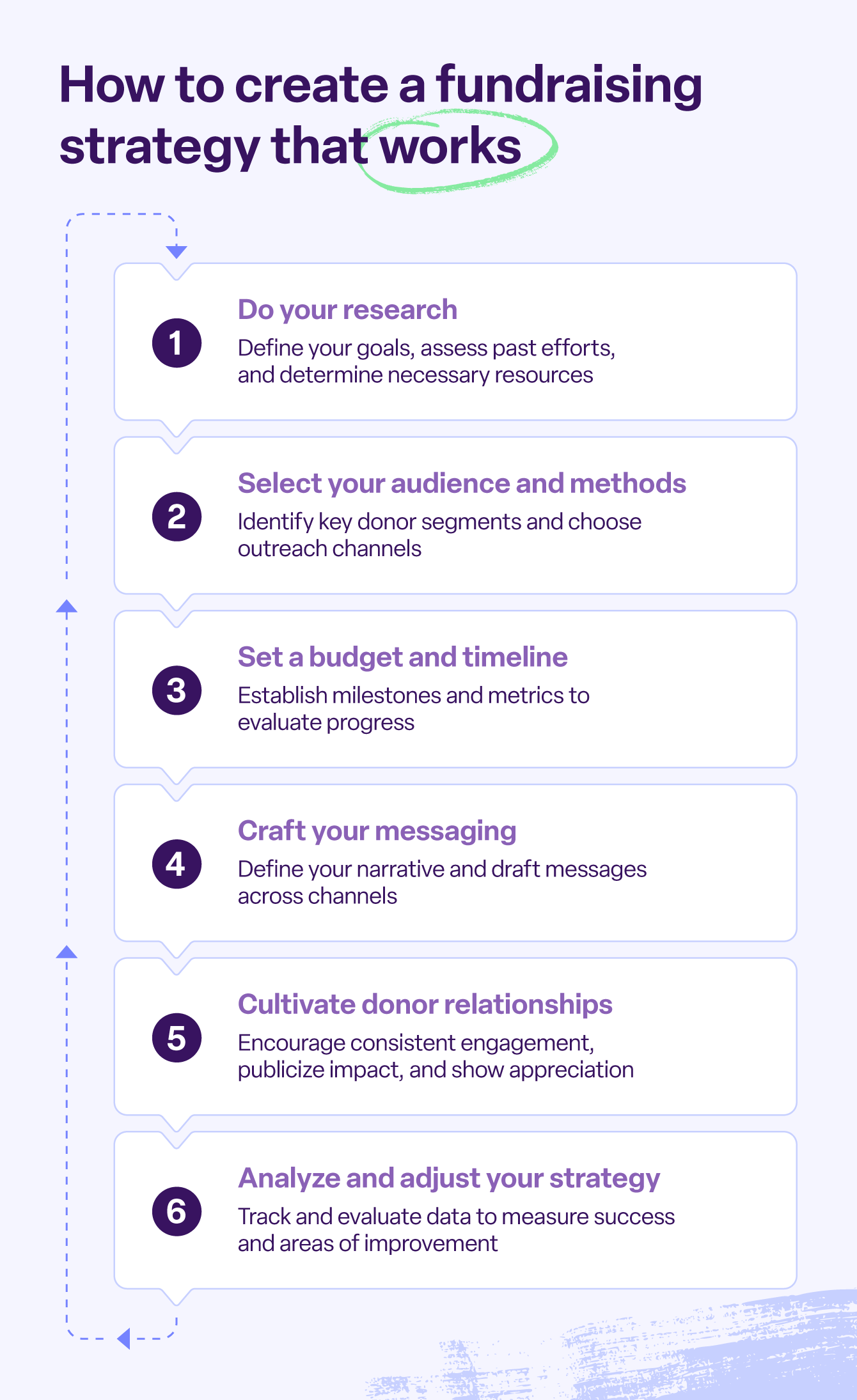
1. Set S.M.A.R.T. goals and clear objectives
First, you need to determine the objectives of your strategy. When doing this, keep in mind the acronym SMART, as this will allow you to design goals that are realistic and will actually further your strategy. SMART stands for:
- Specific: Set clear, well-defined objectives, such as “Raise $25,000 from the annual auction in Q4.”
- Measurable: Determine KPIs so you can track your success. This might be money raised, donor retention rate, or increase in donors.
- Achievable: Goals should be realistic given your organization’s budget, resources, and timeline. For instance, fundraising for small nonprofits may require a smaller scale and fewer resources.
- Relevant: Make sure your goal is in alignment with your nonprofit’s priorities and mission.
- Time-bound: Set a realistic deadline for achieving the goal.
Clearly defined goals will guide your entire strategy, including the actions you choose, how you communicate, and the resources required.
2. Evaluate previous fundraising initiatives
Take a look at past fundraising efforts: campaigns, events, and grant outcomes, then analyze what worked well and what didn’t. Also, pay attention to the cost per dollar raised, average donation size, volunteer engagement, and channel performance.
Use this information to refine your approach by continuing with tactics that work well and brainstorming new ideas to eliminate ineffective or expensive efforts.
3. Craft your narrative and messaging strategy
Your fundraising narrative should explain the importance of your mission and why it matters now. Beyond simply sharing the mission and urgency, use this impact story to clarify the impact donors can make. Strong emotional storytelling can help donors better connect to those served by your organization.
The best way to do this is by crafting consistent brand visuals and messaging across all of your channels (like your website, social media, print, and events).
4. Identify target donors through prospect research
Use prospect research to determine your target donors. Then, segment your audience into groups like:
- Individuals, whether small donors or mid-level supporters.
- Major donors, who are high-net-worth contributors.
- Corporations, who may engage in sponsorships, employee giving plans, or matching gifts.
- Foundations, who might offer grant funding.
- Government, where you may seek federal, state, or local grants.
For even deeper segmentation, look at donor motivations. Consider whether they give because they’re aligned with your mission, want to be directly involved, or are seeking tax benefits. Don’t forget about other details like demographics, interests, and past engagement levels.
Ultimately, you can create donor personas with this information and tailor your outreach and communication to each segment.
5. Invest in a robust CRM for donor data
A nonprofit CRM lets you keep track of donor information, each donor’s giving history, how they prefer to communicate, past involvement, and more. Even better, a CRM can automate outreach and acknowledgements while tracking data over time.
The more data you collect, the better prepared you’ll be to understand your donors and what levers you can pull with a fundraising strategy. With tools like Bonterra’s nonprofit and fundraising software, you can keep track of critical donor data over time, then use this information to craft a comprehensive strategy.

6. Decide on your fundraising methods
A strong fundraising strategy should include a mix of tactics. Different methods require different resources, investments, and timelines. For instance, applying for a grant requires research and compliance, while hosting an event requires logistics and planning. A broad mix can reduce your dependency on a single revenue source and open your fundraising up to a bigger audience.
Here are a few methods to consider:
- Digital campaigns
- Peer-to-peer fundraising
- Events and auctions
- Major gifts
- Recurring donation programs
- Grant writing
- Planned giving
- Corporate partnerships
7. Establish your fundraising budget
Your fundraising budget should cover all the different channels you plan to use. This includes staff work time, software costs, marketing and branding efforts, advertising, donor stewardship, and relevant training for staff and volunteers.
For the most effective budget, break it down by category so you can see exactly what you have to spend where. You can also estimate the cost per dollar raised to see if your investments are financially sound — and make changes if not.
8. Choose marketing and outreach channels
For the most effective fundraising for nonprofits, you want a multi-channel donor journey. This means rather than leveraging a single channel for outreach, you should use as many as possible to capture the largest audience.
Common marketing and outreach channels used in fundraising strategies include:
- Social media
- Direct mail
- Text or SMS messaging
- Events
- Community partnerships
- Video
- Your website
Each serves its own purpose. For instance, email is great for cultivating prospects. Social media is a great way to expand your reach, and personalized direct mail can be helpful for attracting high-value gifts.
9. Develop stewardship and retention plans
Fostering long-term relationships and retaining your donors is often more effective in the long run than solely focusing on donor acquisition. The better the relationship and the more appreciated your donors feel, the more they’re likely to continue giving and supporting your nonprofit.
Develop stewardship plans that include engaging updates, personalized messages, warm thank you letters, event invitations, and impact reports. Depending on the donor segment, you may leverage all of these or just a select few. Either way, the more appreciated your donors feel, the more likely they are to give again.
10. Track and analyze performance
All of this work means nothing if you can’t measure it. That’s why you need to keep a close eye on the performance of your strategies and campaigns. Take some time to determine your nonprofit KPIs and how you’ll track them — your best bet is software that’s designed for this purpose, like Bonterra.
Helpful KPIs include retention rates, conversion rates, gift size, recurring donor growth, ROI for each channel, and cost per dollar raised. When you regularly report on and analyze these metrics, you can quickly adjust your strategy if you find something isn’t working as planned.
Now, let’s take a look at some fundraising ideas to include in your strategy.
28 fundraising ideas for nonprofits
We’ve collected 28 fundraising ideas you can use to deepen engagement, diversify funds raised, and attract new supporters.
1. Express a clear case for support
When you make appeals, be sure to include an impact statement that shows potential donors how their money will be spent and what their gift will achieve, either for your organization or the people you serve.
Your case for support or impact statement should cover the following key points:
- Why you’re raising money and a breakdown of how the funds will be used.
- A list of events and fundraisers related to your campaign that donors can attend.
- A clear call to action and information on ways supporters can get involved.
- How your project will impact (or already has impacted) the community and people you serve.
Having a clear, detailed case for support is important because it shows donors that you have a direction and plan for their money.
2. Make your ask specific
No matter which channel you choose to engage donors, always include an explicit call to action. This lets supporters know exactly how they can contribute and directs them to where they can complete that action. Because the intended action is clear and convenient, there’s a greater chance that a person who sees it will convert.
Remember, not all of your calls to action need to be monetary appeals. The communication strategy works with other actions like volunteering, downloading reports, advocating for issues, sharing a message on social media, or simply signing up to receive your newsletter.
3. Personalize your outreach
Tailor your outreach based on donor data: Thank them for past gifts, reference their specific interests, and use their names for a personal touch. This helps increase engagement and grow the likelihood of a donation.
With Bonterra EveryAction’s automation and segmentation features, you get an easy way to make targeting and personalization scalable even with a large donor list.
4. Encourage recurring gifts
Create a monthly giving program that includes perks for donors. These might include behind-the-scenes updates, exclusive impact stories, or branded swag or welcome kits. Recurring donors tend to give more over time and are often more engaged, so this is a great way to cultivate this segment.
5. Engage your volunteers
Volunteers are often the backbone of a nonprofit. Not only are they out furthering your mission directly, they’re also more likely than others to donate.
Be sure to invite them to fundraising challenges, encourage them to set up peer-to-peer campaigns, and thank them for their continued support of your organization.
6. Harness the power of social proof
Social proof, such as stories from beneficiaries or volunteers, can lend trust and authenticity to your fundraising efforts. They provide specific examples of your mission in action and make it clear how funds raised can benefit your goals.
Gather testimonials from donors, volunteers, and beneficiaries. You can showcase quotes, videos, or case studies on your website or social media, but you can also highlight them at events or in annual reports.
7. Leverage your advocates
Identify major donors, partners, and advocates who are passionate about your purpose. By rewarding them for their hard work and dedication, you can boost their retention, morale, and motivation to help you reach your fundraising goals.
Common incentive examples include:
- Project milestone bonuses
- Annual performance bonuses
- Paid time off
- Personalized gifts
Discuss incentive programs with your directors and your board, and consider surveying your employees. Ask what would make them more committed to the long-term financial success of your organization.
8. Solicit in-kind gifts
An in-kind donation like supplies, furniture, or professional services can reduce your organization’s expenses and support your mission.
Depending on your nonprofit’s mission and objectives, you might use in-kind donations for direct client support, such as clothing or food for underserved individuals you work with. Or, you might leverage in-kind giving for behind-the-scenes organizational work like software installations or marketing strategy.
9. Cultivate high-value donors
Look for prospects who are capable of planned gifting or major gifts. Over time, create and cultivate long-term relationships with high-net-worth individuals who are interested in your mission. To do this, conduct one-on-one meetings, develop stewardship plans, and share impact reports.
10. Explore rebranding
Branding helps your nonprofit stand out against the competition. Every nonprofit should have a brand that is easily identifiable through letterheads, business cards, signage, brochures, and online ads. This includes consistent usage of colors, logos, fonts, and other styles.
With the right design strategy, your brand should automatically communicate who you are and what you stand for. Turn a critical eye toward your current branding and make sure it sends the correct message.
11. Improve your website
Your website is an important part of your overall digital fundraising strategy, so make sure your website is compelling, informative, and serves as a useful tool to steward supporters toward making a donation.
When designing your website, keep these strategies in mind:
- Focus on fundraising. Be sure that donating online is easy for visitors. Include streamlined online donation forms, elevate mobile donation platforms, and embed compelling calls to action throughout the site.
- Mobile functionality. Optimize your mobile giving channels by making sure your online donation forms are easy to use from mobile devices, especially smartphones. You should also implement text-to-give campaigns to encourage supporters to donate via SMS messaging. This is a great way to capture immediate interest from supporters at events or those on the go.
- Create cohesion. All aspects of your website should reflect your brand, so users are always aware of your organization while they’re browsing. Stick to one color scheme, formatting, and font throughout to avoid confusing your visitors.
- Tell your story. Websites that feature a heartfelt story are more likely to engage browsers and encourage giving. When readers understand why you’re so passionate about the cause, they’ll trust your organization and want to follow along.
You should also make sure your navigation is clear and that you feature the most important links (like the one to your donation page) in an obvious place so that when people want to find them, they can.
12. Invest in content marketing
Content marketing can help nonprofit organizations bring in new supporters from the top of the engagement funnel. It involves the creation of educational content that is optimized for topics that your audience may be interested in.
For example, you might create educational articles, nonprofit news and reports, and informational webinars and video content.
By curating content about your cause, activists in your field, or other topics your supporters are curious about, you can lead them to your site and convert casual readers into passionate donors.
You could even create a blog to organize these resources and build an ongoing engagement and lead-generation machine directly into your website.
13. Master video creation
Video is one of the fastest-growing and most used mediums in nonprofit communications. Consider using video for the following activities:
- Emergency fundraising appeals
- Relief trip updates
- Thank you videos from those you’re helping
- Volunteer stories
- Campaign or fund progress updates
If you have the budget to work with video professionals, you can put together a sophisticated product that enthralls and delights. If not, don’t get stuck on endless tweaks. With amateur video, it’s important to remember that “good enough is good to go.” Social media audiences are very forgiving of low-budget video work when the message is for a good cause. The important part is getting your message out there and giving it a chance to succeed.
14. Update your social media strategy
Social media platforms are excellent places to identify potential donors and start engaging them on their terms. Each platform has unique capabilities and audiences.
If your audience is professional and likes research material, perhaps LinkedIn is the first place you should start posting content. If your audience is younger, TikTok and Instagram might be appropriate.
Test your message on different social networks to see which brings the best conversion rates and other important nonprofit KPIs, then adjust your plan accordingly.
15. Split-test online donation pages
The optimal donation page varies from nonprofit to nonprofit, but the goal is to make the experience as convenient as possible for your donors so they’re more likely to contribute. You can use split testing, also known as A/B testing, to gauge which version of your donation form will be the most engaging.
Conduct split testing by creating alternative versions of your donation page with only one difference per version, such as a new title or a different color donation button. Send portions of your audience to the different versions of your donation page and track which form converts the most donors.
When the test is done, rework your final form to mirror the look and functionality of the winning version from the split test.
16. Run sophisticated advertisements
Retargeting ads allow your nonprofit to show targeted ads to the users who visited your website and didn’t complete a conversion. Retarget visitors to your website with ads that follow them on any device they use.
This is a highly valuable way to reconnect with a number of potential supporters who don’t convert on their first visit to your site. It’s also a great way to follow up with additional information related to the content in which they showed interest.
For example, let’s say a visitor lands on a donation page for a specific program but chooses not to make a donation at that time. Your retargeting ad about that specific program will be shown to that visitor the next time they visit Facebook on their mobile phone or their computer encouraging them to click back and finish what they started.
17. Don’t forget traditional media
With the current marketing focus on digital media, it’s easy to overlook more traditional advertising methods like flyers, direct mail, and print advertising. These can be effective fundraising methods used alone, but when used in combination with digital efforts, they can supercharge your nonprofit fundraising strategies. Use each method to reinforce your message and pursue a well-rounded multichannel marketing strategy.
Even with the prevalence of digital giving channels, 16% of donors still prefer to give via direct mail. While younger donors might prefer communicating through social media, older donors typically prefer direct mail. Using only one or the other may limit your potential audience.
18. Consider online partnership programs
If you know where to look, you can often form corporate partnerships right from the comfort of your home office. These online partnership programs are offered by large retailers and media companies that give back by splitting a portion of their profits or sales with nonprofits.
You’re not likely to receive donations as large as your typical corporate sponsorship, but online partnership programs can generate steady income without requiring much work on your part. For example, Goodsearch is a company that pays you to search the web by splitting its advertising earnings with you.
19. Form strong corporate partnerships
While individual contributors will likely account for the majority of your fundraising dollars, there are a host of nonprofit partnership opportunities in the corporate and for-profit industries that can support your purpose.
A good corporate partnership is mutually beneficial and helps the sponsor achieve their goals too. If you’re interested in getting sponsorships, there are a few types of corporate partnership opportunities you can explore:
- Volunteerism and volunteer grants: Many corporations encourage their employees to get involved with local nonprofits. Some give teams time off to volunteer. Empower a corporate champion, like an existing donor or volunteer, to post flyers, ask colleagues for donations, assemble volunteer groups, or form peer-to-peer teams at work.
- Challenge grants: Your organization can strengthen your charity fundraising strategy by participating in corporate challenge grants, wherein a corporate sponsor agrees to donate a certain dollar amount once your fundraiser has met an agreed-upon fundraising goal, such as a percentage of dollars raised or a flat fundraising benchmark.
By teaming up with your organization, corporations can fulfill corporate philanthropy requirements while also benefiting from low-cost advertising and the goodwill that comes with helping good causes.
20. Find matching gift opportunities
There are scores of corporations that will match the donations made by their employees to local nonprofits. Taking part in a gift-matching program essentially doubles the donations you receive without having to expend double the work. It’s a win-win for you, the donor, and the donor’s employer, who, like with corporate sponsorships, gets to partner with a local organization and do more good in the community.
21. Utilize crowdfunding
Crowdfunding involves setting up an online donation page and collecting small donations to reach a specific goal or accomplish a particular project. This approach encourages your supporters to pitch into the campaign, regardless of donation size, and pass the message along to their communities.
This is a great marketing tool, as it involves people sharing your campaign across different platforms in a way reminiscent of a peer-to-peer campaign. Additionally, this straightforward online fundraiser allows every social good organization — from small charities to huge nonprofits — to engage their audiences and stir up a groundswell of support.
22. Leverage celebrity endorsers
Associating your cause with an athlete, entertainer, or politician can be highly rewarding for your organization. If you discover a personal connection between your organization and a celebrity, it might be worth reaching out and making an introduction. If you’re lucky, the celebrity will even reach out to you.
Do your research and see what celebrities are talking about, the causes they support, and the issues they get involved with. When you find a match, make the intro.
23. Collaborate with nonprofit influences
Social media marketing and fundraising have become one of the most powerful additions to many nonprofits’ toolkits. To expand your reach on popular platforms, consider reaching out to an influencer and asking if they’d be willing to share your content with their followers.
Nonprofit social media influencers command a considerable amount of respect and attention in their own niche realm of the nonprofit sector, giving them direct access to audiences that are likely receptive to your cause.
By partnering with these figures on social media, you can strengthen your reputation and reach some of the most important target audiences for your brand.
24. Host an event
There are a few types of events to add to a fundraising strategy for nonprofits:
- A major event, which is one big event that includes many smaller events. Think conferences, multi-band concerts, or even fairs with multiple booths and programs. Try partnering with local businesses, artists, or celebrities. Just make sure you have a volunteer or staff member at each activity to take contributions and help you oversee the effort.
- A smaller event, like a local 5k run or walk, film screening, or workshop. These are often less effort and less cost, but can still bring in funds for your organization.
25. Enlist professional help
Everyone knows that nonprofit staff often wear multiple hats around the office. But some tasks require professionals. Big events, for instance, can often benefit from your organization hiring a coordinator to make things run smoothly. This way, you’ll spend less time on logistics, so you can focus on delighting your attendees and maximizing the event ROI potential.
You can also leverage professional support for projects like branding, marketing, CRM implementation, or grant writing.
26. Create a recurring tradition
Once you’ve held a successful event, why not recreate it? That’s the idea behind most walk-a-thons and other annual events. Nonprofits that document the process they went through to hold the first event are in a great position to replicate that process year after year and benefit from the additional exposure they gain in the community.
This goes beyond events, too. Perhaps your organization can hold a peer-to-peer fundraiser to mark a specific occasion each year.
27. Embrace new and innovative opportunities
If your supporters are getting tired of the same old thing, try to branch out with new engagement opportunities. In order to keep donors coming back for more, you want to keep exciting them with new surprises.
For your event strategy, if an annual dinner/auction is the norm, why not bring in some slot machines and gaming tables and make it a casino night? You’ll still get the benefits of an annual event and hold your supporters’ interests year after year.
This also applies to virtual fundraising. Consider virtual events, QR donation codes or text-to-give options, or leveraging AI-driven donor insights to help you discover new ways to delight your supporters.
28. Find ways to reduce costs
Some fundraising efforts might not bring in quite as much as a major event, but they cost little to nothing to run and require less staff investment.
Here are a few ideas for affordable options:
- 50-50 raffle: Your organization raises money by selling raffle tickets to supporters, then the nonprofit and the winner split the proceeds evenly, so there is nothing but upside for the nonprofit.
- Skills-based events: These are fun because they bring your community together to show off their skills and enjoy watching the talents of other supporters. Some popular ideas for skill-based events include talent shows, battle of the bands, and spelling bees.
Other low-cost options include seeking sponsorships, leveraging in-kind donations, or encouraging volunteer-led activities.
How to implement a fundraising strategy
Starting a fundraising strategy begins with aligning your staff, board, and volunteers around the goals, metrics, and channels you plan to use. For the most organized strategy, assign ownership for each task and document the expected timeline for the work.
You’ll also want to set the right expectations for reporting and analyzing metrics.
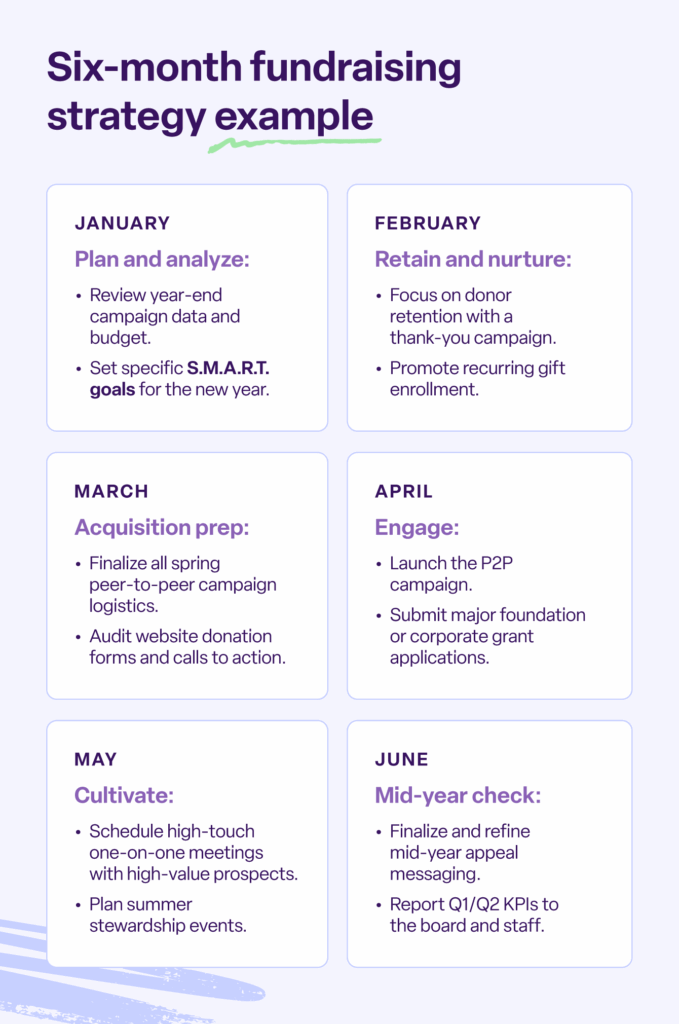
Align on goals, channels, and key KPIs
Begin by aligning on fundraising goals, the channels you’ll use, and the metrics or KPIs you’ll use to measure your success. Metrics to consider include:
- Revenue goals
- Priority donor segments
- Fundraising methods
- Outreach channels
- Metrics, including retention, recurring donor growth, and average gift amount
Facilitate a grassroots fundraising strategy
Grow your audience with grassroots supporters who are well-equipped to spread the word about your cause. One of the best ways to drive grassroots support is through peer-to-peer fundraising campaigns.
By mobilizing your existing donors to fundraise on your behalf, you gain an introduction to people who might not have otherwise connected with your organization.
Encourage supporters to create their own fundraising page, complete with their personal cases for support, photos, videos, and fundraising trackers. Then, they can begin advocating for your cause and raising funds online from their friends, family, and personal networks.
Get to know your donors
Rather than sending out a mass appeal, get to know your donors and present your cause in a way that’s compelling to them. Customized, relevant content helps boost engagement and inspire more meaningful support.
Plus, taking a personalized approach to each of your donors is easier than ever, thanks to the help of donor management software. Use the tool to track valuable donor information such as:
- Demographic and contact information
- Familial, household, and business relationships
- Giving and involvement history
With this information, you can better understand your donors and segment them into groups based on shared characteristics. Then, you can target them with individualized outreach strategies that feature relevant content, such as donation appeals that match their last donation amount.
Launch donor recognition programs
The best way to engage your existing donors and inspire recurring gifts is to thank them. Donor recognition programs call attention, both publicly and privately, to the people who help your organization realize its impact.
To get started, use your fundraising CRM to automate donation thank you letters after a gift is made. This will help improve your retention rates and increase the likelihood of earning recurring contributions.
Exert influence on public opinion
Exerting influence on public opinion is the surest way to affect policy changes with legislators at all levels of office. Invest in advocacy software that allows you to mobilize your supporters to take action. Look for nonprofit fundraising software with features that accommodate activities like:
- Signing petitions
- Sending out emergency email appeals
- Identifying local legislators
- Conducting texting campaigns
With each of these actions, you gain valuable information from your donors and supporters. Get to know their motivations and leverage them for future marketing.
Empower your fundraising efforts with Bonterra
Regardless of the specific tactics you choose, your fundraising strategy should always be a work in progress. Turn a critical eye toward analytics and hone your data-driven storytelling accordingly for the greatest outcome.
When starting to learn how to fundraise for nonprofits, consider Bonterra EveryAction or Network for Good.
Bonterra EveryAction is a great fit for mid-market to enterprise-level organizations. It offers advanced segmentation, robust automation tools, and deep data and reporting features — making it helpful for complex campaigns and high-volume fundraising.
Network for Good, on the other hand, is excellent for smaller nonprofits. It’s user-friendly and offers straightforward donor management and outreach tools, as well as intuitive dashboards to track all the data you need.
Both platforms centralize your donor information, automate personalized outreach, and give you real-time insights into how your campaigns are performing so you can make strategy adjustments as needed.
Request a demo today to see how Bonterra can transform your fundraising strategy.
FAQs
What is the fastest way to raise money for a nonprofit?
The fastest ways for a nonprofit to raise money are often time-limited digital donation appeals, peer-to-peer fundraising, crowdfunding, or matching gift challenges. These create a sense of urgency and competition, leading to quicker results.
What fundraising KPIs should I track and how do you measure them?
The most important fundraising KPIs to track are:
- Donor retention
- Donor acquisition rate
- Average gift size
- Conversion rate
- Cost per dollar raised
- Channel ROI
- Recurring donor growth
You can measure these by comparing year over year performance, analyzing data from campaigns, and leveraging data and reporting from nonprofit CRM software.
What are the 5 P’s of fundraising?
The five P’s of fundraising may vary depending where you look, but typically they are people, purpose, plan, process, and performance. These typically refer to the core elements that a strong fundraising strategy requires.
What are the 4 C’s of fundraising?
The four C’s of fundraising are often considered to be connection, communication, consistency, and commitment. These highlight the relationship building principles driving engagement and retention.
What is the 80/20 rule in fundraising?
The 80/20 rule in fundraising is that roughly 80% of a nonprofit’s revenue typically comes from 20% of its donors. This underscores the high importance of donor segmentation and cultivation of major donors.


Don't miss out
Get the latest insights delivered to your inbox.


